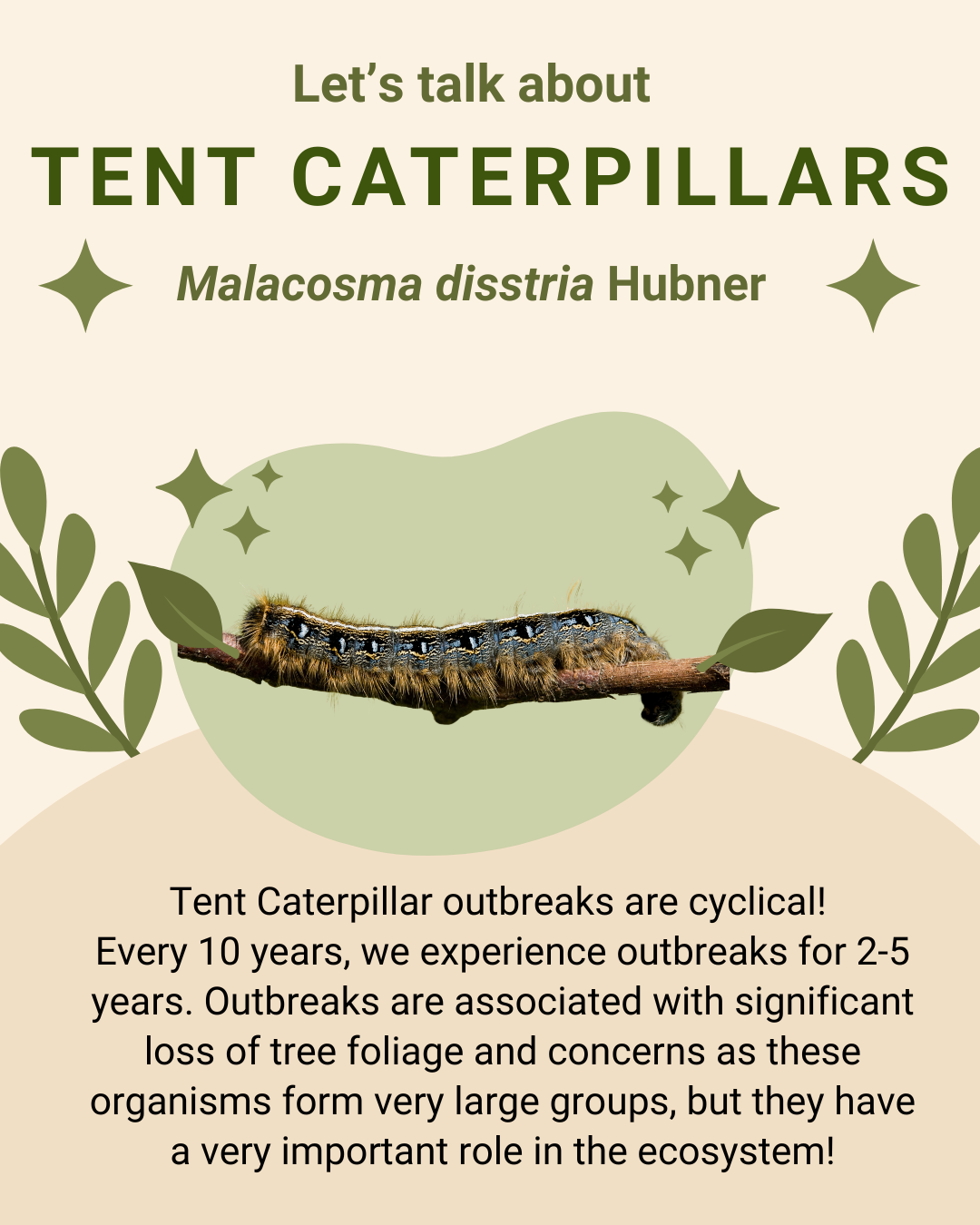
Tent caterpillars are a native pest in Alberta that have cyclical outbreaks lasting 2-5 years every 10 years. Tent caterpillars are known for being very prolific consumers of foliage, causing massive leaf loss to trees and forming very large groups that can create slippery conditions if the caterpillars are stepped on or driven over. There are multiple species of tent caterpillar, including the eastern, forest, and western tent caterpillars. The forest tent caterpillar, Malacosoma disstria is the one most
Identification: the forest tent caterpillar is blue with black stripes and white “keyhole” pattern along their backs. The egg masses will be greyish-brown, and form foam like bands surrounding a branch or twig.
Life cycle: Tent caterpillars emerge from eggs in the spring and immediately begin a feeding frenzy, consuming massive amounts of vegetation. This stage is what causes the bare trees that are sometimes associated with tent caterpillar outbreaks. Next, the forest tent caterpillar that we see in Alberta actually creates a silk mat for the pupal stage, versus the silk “tent” that other tent caterpillar species build. The insects then transition into their adult moth stage, and mate. After mating, a female will lay 150-250 eggs in a band around twig. Females will only lay once per year, so there is only 1 generation of tent caterpillars per season. The eggs remain over winter, emerging again in the following spring!
Impact:
Tent caterpillars have been well recognized for causing trees in an entire area to lose their leaves, however trees typically do not die from the loss of their foliage. Trees who have lost their leaves will be more susceptible to other stressors like disease and drought which can cause the death of the tree, but typically they recover from a single tent caterpillar season. Trees that are feasted upon several years in a row may experience die-back, where the branches will die and growth will be reduced, which can have a significant impact on the lumber industry. These stressed trees will also produce significantly less fruit than trees with intact foliage.
It is important to note that while tent caterpillars can harm trees, they are still extremely important species to the ecosystem! The caterpillar larval stage is an optimal food source for baby birds due to the high protein, appropriate fat content, and easily digestible material (since they do not possess a hard exoskeleton like other insects such as beetles do).
Management:
When deciding how to manage tent caterpillars, consider the population size and the expected impact that population will have! Caterpillar outbreaks tend to resolve as disease spreads among the populations (typically viral agents), so management often is not needed and efforts can be directed at supporting affected trees through watering and pruning dead branches.
If management is required, the most effective way to reduce the caterpillar populations is to destroy the eggs in fall or early spring before hatching. Caterpillars can also be scraped off branches, hosed off, or crushed.
BtK (Bacillus thuringiensis var. kurstaki) is a biological insecticide that can be applied to foliage in the spring, and when the caterpillars consume the treated leaves they will die. This insecticide specifically is much more specific to caterpillars as it an alkaline Gastrointestinal tract (birds and mammals have an acidic digestive tract), as well as receptors in the gut for this product to bind to (some other insects including bees do not have these receptors, so would not be harmed). It can still impact other species of caterpillars, including those that become butterflies.